

This Post Is 70% Nostalgia, 30% Dial-Up Rage, and 0% Interested in Your App
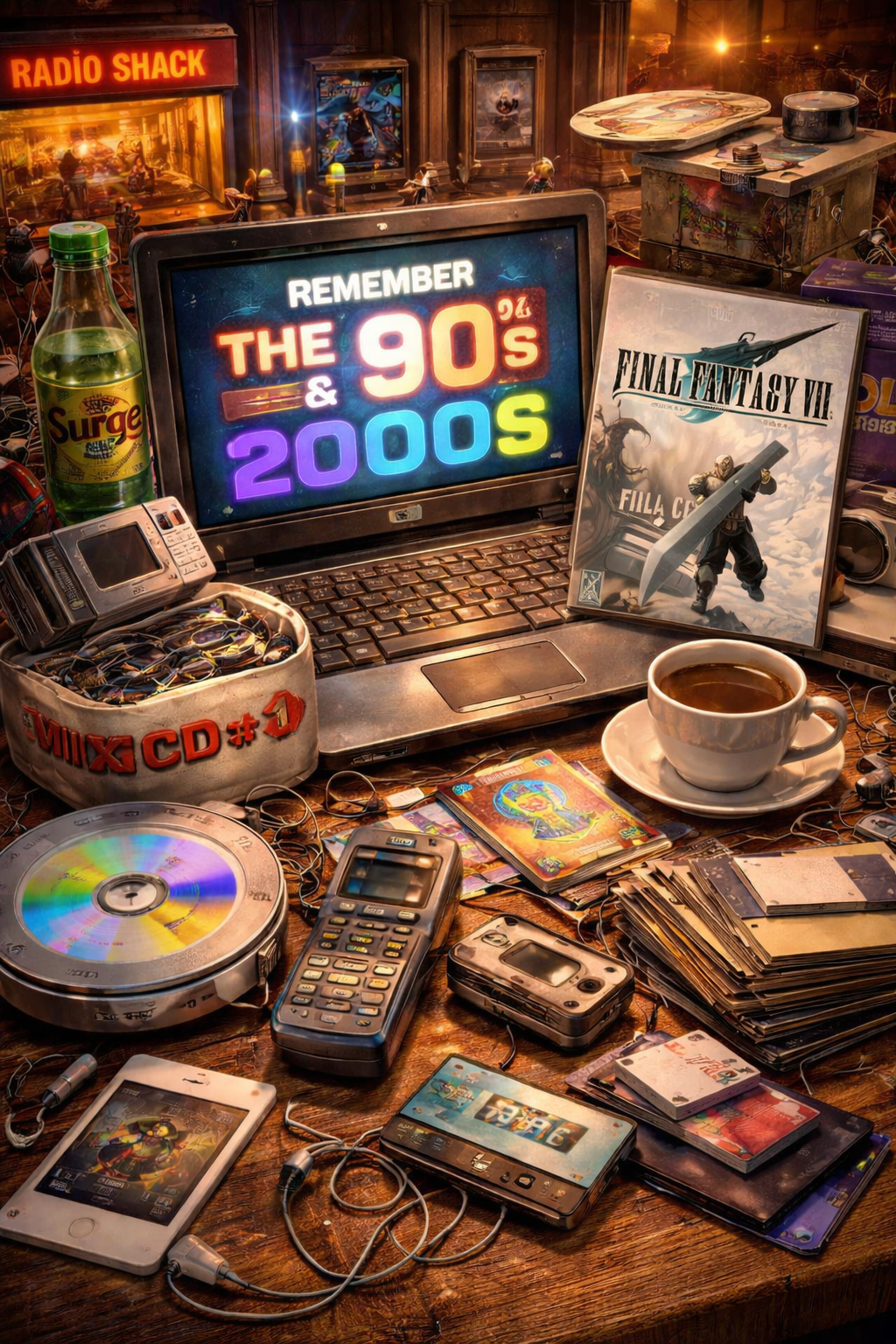
Growing up in the 90s and early 2000s, tech was a foundational part of my childhood.
I remember discovering proxy services in 98′ and used them to circumvent the school’s library web filters. I got suspended for a week. Ahh, the good ol’ days.
I spent more time on a computer than I can remember. Getting my license at 16, I remember buying a pack of 100 CD-R’s and used them to make mix CD’s for my car and for my friends. Then, what seems like in a blink of an eye, CD’s change to MP3s. (Thankfully, my AIWA head unit could read mp3’s right from a cd, which meant 30 – 50 songs instead of the 12 – 18.)
Then came my first cellular phone. It was a Sanyo with a green backlight. It looked like a smaller version of the ‘Zack Morris’ phone from Saved By the Bell. My first phone bill was over $300! That’s when the term ‘nights and weekend minutes’ was termed. I just didn’t know about it yet….
Don’t get me started on Dial-up! I would be right in the middle of downloading an MP3 – 30 minutes into it with another 20 to go, and someone would pick up the phone! AAGH! I’m not sure what I hated more – that happening, or my parents signing up for ‘call waiting’! In case you don’t know what that is, it was a feature on landlines in the 90’s where if you were on the phone talking to someone, and someone else called you, instead of them getting a busy tone, you would hear a set of beeps on your end, letting you know someone was calling you. Wreaked havoc on a dial-up connection.
That was also the golden era of gaming. The first Playstation was released, which was the first console to use CD’s to load games. I remember Final Fantacy 7 had 3 or 4 disks because they integrated a bunch of video cut scenes. And it was amazing! Especially coming from a Super Nintendo and Sega Genesis.
My cellphone I mentioned earlier, I bought it from a brick and mortar store. Not no Amazon. I went into Radio Shack! At that time, Radio Shack and Circuit City were better than amusement parks for me and my friends! Oh how I wish Radio Shack was still around. I’m only able to continue in life because I found a Microcenter near where I live several years ago. Everytime I go in, I hear Angels singing, and no matter how down I might have felt walking in, all that goes away and I always leave feeling better than ever.
Why am I reminiscing? Some could argue that today, we have all that, and so much more! And that would be true. In the early 2000s, tech began a decades-long consolidation. Almost everything we used before became a function of a single device. Objectively, this was an improvement—old VCR interfaces were awful, early MP3 players were clunky, GPS lacked real-time traffic data, and nothing talked to each other. And yet, through that consolidation, something intangible was taken from us.
Our devices lost their unique personalities. Phones became our alarm clocks, flashlights, calendars, watches, cameras, GPS units, music players, radios, journals, and gaming devices—all at once. We betrayed our focus in the pursuit of convenience, and the personality of our devices for homogeneity.
This convergence created winner-take-all (and two-player) markets. Console gaming became PlayStation or Nintendo. Phones became Android or iOS. Computers became Mac or Windows. PC gaming became synonymous with Steam. Everything else became a feature inside one of those platforms, with globally synchronized updates making our experiences increasingly uniform, and bland.
For a long time, that felt inevitable. But it’s only become clear in retrospect that somewhere in the early 2020s, things started to change.
New paradigms are emerging for the first time since mobile. VR is no longer experimental. Early AR is starting to reach consumers. Meta shipped a wearable that normal people actually use, thanks to a clever Ray-Ban partnership (and associated equity stake). 3D printers have become real household products. Wearables are diversifying—smart rings, over-the-counter glucose monitors, connected beds.
Meanwhile, Apple’s aggressive push for services revenue has alienated developers and users alike, creating space for alternatives. And nostalgia has revealed itself as massive, underserved economic demand.
Thinking back to my youth, I was totally and completely absorbed in Star Trek: TNG. If your a techie nerd like me, you know what i’m talking about. (And if your in IT and don’t like Star Trek, just leave. NOW) Do you remember when the crew would go to the holodeck, and re-enact times from what then would seem centuries ago? Picard loved the Dixon Hill holo-novels. There’s a joy in seeing Captain Jean-Luc Picard, a serious man who enjoys Shakespeare, delight in pulpy detective fiction. Or do you remember the episode that was entitled ‘A Fistful of Datas’ where Worf was having trouble bonding with his son Alexander? Hoping to bond like Klingon warriors, Worf participates in a Wild West hologram program at Alexander’s request. Due to a freak accident, the outlaws and residents of the Wild West town all look and sound suspiciously like Data.
And there are so many more episodes that should I list, especially across the entire franchise, my fingers might actually break from all the typing! But I remember back then, being 10 years old, thinking ‘Why are they so interested in the past? I would rather use the holodeck for something more futuristic’. And yet here we are. Gen-Z is buying single-purpose iPods and wired headphones. Pokémon cards are trendy. My friends and I are amassing N64 game collections again. There is a revived appetite for film cameras and Polaroids. Companies are recreating old hardware in modern form—ModRetro’s upcoming FPGA-based M64 plays native N64 cartridges, following their successful Game Boy recreation. They’re now working to bring a “next-gen” CRT monitor to market. The Playdate proved there’s still room for third-party handhelds with their own unique philosophies. Even Nintendo couldn’t resist capitalizing with the re-release of their classic consoles.
Tech is starting to resemble the wristwatch market: collaborations, limited editions, exclusivity. A market with many players—emerging companies, niche studios, design-forward brands, and even failing companies—is healthier than one dominated by a few giants. Apple’s push toward services has been financially successful but culturally damaging. Users are looking elsewhere. It was imperceptible at first, but that sentiment is spreading. In fact, just recently, a Timex ad went viral: “Know the time without seeing you have 1,249 unanswered emails.” People are gravitating toward rigid, single-purpose experiences that let them fully disengage!
Barriers to entry are lower than they’ve been in decades. Software can be deployed in minutes. Hardware is still hard, but 3D printing has revolutionized prototyping and accessible manufacturing services have drastically lowered the cost and time to market. Even the consolidation on the USB-C standard has played a role, allowing switching devices without investing in a new ecosystem.
Now, in 2026, the one thing I have wanted, I have longed for since I was a child, is no longer something existing in imagination or on the USS Enterprise. Artificial Intelligence is here. THIS is why I am so excited to live in 2026! The many episodes where Geordi, or Data was working with the computer to build some high tech solutions to solve the Enterprise’s imminent demise, Is how I have been using AI.
This classic season 3 episode ‘Booby Trap’ has Geordi racing against time to prevent an ancient booby trap from killing the Enterprise crew. The trap involves energy converters which drain power from the Enterprise, and feed it back to the ship via lethal radiation bursts. Geordi calls up a hologram of Leah Brahms, a propulsion designer for the Enterprise, and the two work out a solution to escape the trap. That’s how I use, and plan to continue to use AI. Not as something to do all the work for me, that’s no fun, and I wouldn’t learn much. But as a tool to complement myself. Something to bounce ideas off of. Something to use for calculations that would take myself days, weeks, or longer to complete, that it would finish in a fraction of that time.
Because of AI, there is now a blurring of the line between a Systems Administrator, and a Software Engineer. Have a problem that would cost more money than what it’s worth? Build the solution myself! Find an amazing Github project that runs on Windows but not native to Linux? I’ll port it over, and refactor the code myself! The possibilities are endless!
If you read my post and made it here, I want to say thank you. This was more of a rant than something productive, but it felt really good to write (especially the walk down memory lane!) When my daughter asks not for a USB thumb drive, but instead a pack of Polaroid instant film for her camera, I am going to gladly buy it for her. And when my other daughter asks me for a new music album, not on iTunes, but on Vinyl, you can bet your smartphone we’ll be in the car and on our way to Walmart faster than you can say Onomatopoeia! And when my son, brings his deck of Pokemon cards to me to show what he put together, then asks for money to buy the one last card needed to complete his deck, I will gladly pretend to know what he’s talking about while sending him money via cashapp.